
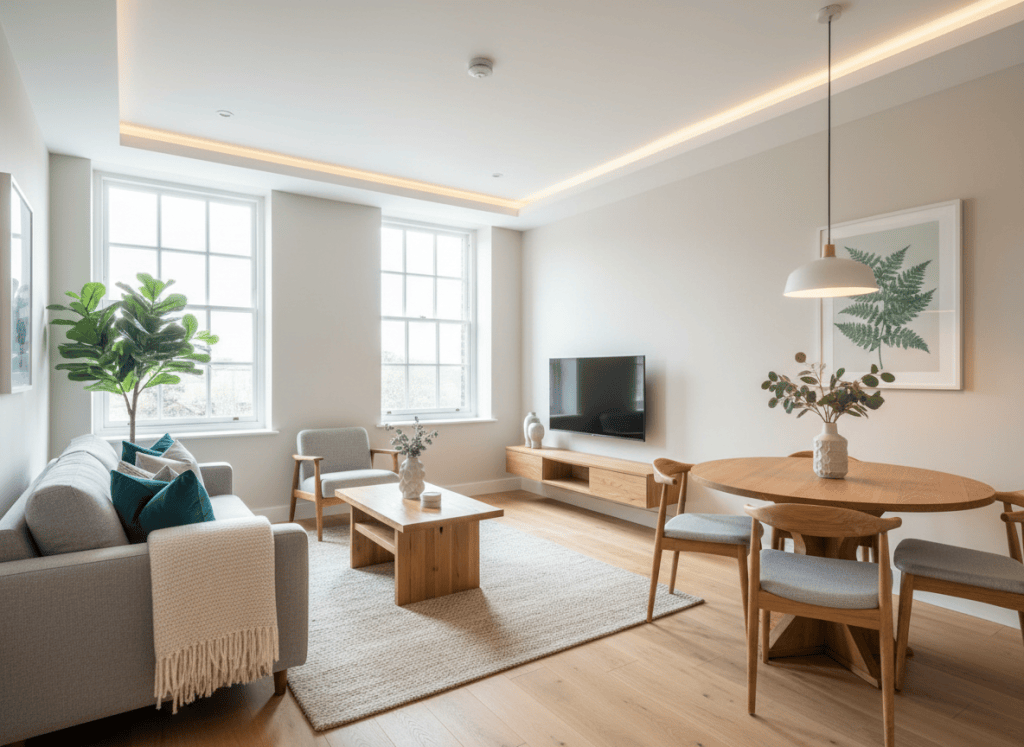
Buying, leasing or operating serviced accommodation away from where you live can make the furnishing stage one of the most time-consuming parts of the project. The challenge is rarely choosing one sofa. It is coordinating hundreds of decisions and practical steps while you are not on site.
A genuine turn-key furnishing service is designed to remove much of that coordination burden. The goal is to take the property from an agreed brief to an attractive, functional and guest-ready space without the investor having to manage every supplier, delivery and installation personally.
Why out-of-area set-ups become complicated quickly
- Multiple suppliers deliver on different dates.
- Large furniture deliveries may need someone on site for long windows.
- Items can arrive damaged, incomplete or substituted.
- Flat-pack furniture needs assembly.
- Packaging can build up rapidly.
- Room dimensions may make apparently suitable furniture impractical.
- A property can be “full of furniture” and still look unfinished.
- Missing kitchenware, linen or guest essentials often only become obvious at the end.
When the investor is several hours away, each problem can mean another journey, another day away from work or another contractor to coordinate.
Start with the guest before the shopping list
For an out-of-area investor, it can be tempting to begin with furniture packages and product lists. The more important starting point is the intended guest. If you do not know who you are furnishing for, it is very easy to spend money in the wrong places.
The guest profile affects almost every practical decision: bed and mattress quality, storage, seating capacity, dining provision, workspace, laundry facilities, kitchen equipment, styling level and even how much emphasis should be placed on photography-led design.
A contractor property, family stay, corporate relocation unit and premium leisure property can all have the same number of bedrooms but need very different specifications. Understanding the guest first allows the project to meet expectations rather than simply fill rooms with furniture.
What a turn-key SA furnishing process should look like
Stage 1 — Property review and furnishing brief
The project should begin with the property itself, not a shopping list. We look at the number of rooms, floor area, guest capacity, existing features, access, location and intended market position.
The target guest matters. A property aimed at corporate relocation may benefit from different furniture, workspaces and kitchen provision from a short-stay leisure property. A larger family property will have different seating, dining and storage needs again.
Stage 2 — Agree the specification level
Before sourcing starts, the project should be positioned as Standard, Premium, Executive or Bespoke. This prevents “specification creep”, where a project starts with one budget and gradually accumulates higher-cost choices without a clear commercial reason.
For suitable local properties up to three bedrooms, the Standard SA package provides a controlled starting point. Larger, more distinctive, premium or higher-value properties are quoted individually.
Stage 3 — Room-by-room furniture plan
Each agreed room needs a clear function and specification. That includes major furniture, but also lighting, accessories, linen, kitchen equipment and agreed guest essentials.
This stage is where practical questions are resolved: How many people can sit in the lounge? Does dining capacity match sleeping capacity? Is there enough clothes storage? Is a workspace needed? Will the furniture fit through the access route?
Stage 4 — Supplier sourcing and item selection
Sourcing is about more than finding items that look good individually. Furniture and accessories need to work together visually, fit the dimensions, meet the agreed budget and be reasonably available within the project timeline.
For higher-specification projects, this can develop into a fuller design concept with enhanced furniture, statement lighting, artwork, premium soft furnishings or detailed FF&E specification.
Stage 5 — Ordering and delivery coordination
Once the specification is approved, orders need to be placed and tracked. A coordinated installation works best when deliveries are planned around property access, installer availability and the practical sequence of the set-up.
This is also where regional and national projects need realistic logistics planning. Travel time, mileage, parking, tolls, accommodation, restricted access or additional labour may need to be priced separately.
Stage 6 — Assembly and installation
The property then moves from boxes and deliveries to functioning rooms. Furniture is assembled, placed and checked against the plan. This stage often exposes small practical issues that were impossible to see on a product page — clearances, door openings, cable positions, sightlines or a room feeling visually unbalanced.
Stage 7 — Styling and final presentation
Styling is not simply adding decorative objects. It is the stage where rooms are balanced, accessories are placed, soft furnishings are finished, lighting is adjusted and the property starts to feel coherent rather than newly delivered.
On Premium and higher-level projects, this can include stronger styling concepts, statement pieces and photography-ready presentation.
Stage 8 — Snagging and guest-ready handover
Before handover, the property should be checked room by room. Missing items, damage, incomplete assembly or presentation issues are identified and logged. The aim is to hand over a completed set-up rather than leave the investor with a final list of jobs to discover themselves.
What can still fall outside a turn-key quote?
“Turn-key” should not mean an undefined promise that every possible cost is included. A professional quote should be clear about the agreed scope and identify variables before purchasing starts.
- Properties over the agreed size or bedroom count.
- Additional living rooms or unusually high guest capacity.
- Premium or bespoke items.
- Difficult site access.
- Regional, extended or national travel and accommodation.
- Storage and unusual delivery requirements.
- Waste removal if outside the agreed installation scope.
- Extra visits caused by project changes.
- Damage replacement and supplier issues requiring additional work.
- Photography preparation, refreshes or replenishment where separately requested.
Why this model suits investors building a portfolio
Once an investor begins setting up multiple units, repeatability becomes valuable. A consistent furnishing process can make it easier to control budgets, maintain a recognisable standard and reduce the time spent reinventing every property from scratch.
Gem Does Staging also supports multi-property set-ups, property refreshes and ongoing furnishing requirements as portfolios grow.
What to send when requesting a quote
- Property address and postcode.
- Number of bedrooms and bathrooms.
- Approximate floor area if known.
- Photos, floorplan or listing link.
- Expected guest capacity.
- Target guest and intended positioning.
- Existing items to retain.
- Target launch date.
- Any known access restrictions.
- Whether you require full turn-key delivery or procurement-only support.
If you are managing a project from a distance, the service should reduce the number of separate decisions and site visits you personally need to handle — while still giving you clarity over the specification and budget.
See the turn-key furnishing and staging service, check where we work, or send through a project enquiry.

